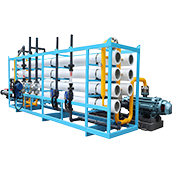
Large-scale Reverse Osmosis Equipment: Centralized Industrial Water Treatment Solution
Large-scale reverse osmosis equipment serves as the core centralized water purification facility for heavy manufacturing groups and industrial parks. Our configurable systems support containerized layout, can achieve recovery rate ≥75% and stable product water conductivity <10μs/cm. We supply supporting services including RO equipment remote monitoring system, industrial RO equipment energy-saving retrofit, RO equipment retrofit/upgrade, and can coordinate the construction scheme of medium-scale reverse osmosis equipment. Optional configuration includes explosion-proof industrial RO equipment and carbon steel epoxy-coated frames to adapt to chemical, power plant and outdoor operating environments.

Product Description
Large-scale reverse osmosis equipment refers to skid-mounted or containerized integrated water treatment units with hourly water output generally exceeding 20 tons/hour, designed to satisfy continuous, high-volume pure water demand of industrial parks and large factories. Unlike medium-scale reverse osmosis equipment built for independent small workshops, this series adopts parallel multi-stage membrane arrangement to realize stable continuous operation for 24 hours all year round. Clients can choose containerized reverse osmosis equipment for projects lacking fixed factory buildings, or select carbon steel epoxy-coated RO equipment and explosion-proof industrial RO equipment for flammable, corrosive and outdoor installation sites.
We provide one-stop service from equipment sizing, drawing design, on-site installation guidance to long-term operation optimization. Existing production facilities can select industrial RO equipment energy-saving retrofit and RO equipment retrofit/upgrade to expand capacity without constructing new production lines. Every system can be fitted with the RO equipment remote monitoring system, helping plant managers track operating data of dozens of membrane trains simultaneously. Standard finished models include 50 T/H output reverse osmosis equipment, and we support fully customized parameters according to local raw water quality and industrial RO equipment acceptance criteria.
Working Principle
The separation core of large-scale reverse osmosis equipment relies on multi-train parallel reverse osmosis membrane separation technology. Multiple groups of high-pressure units supply pressure to independent membrane racks synchronously. Raw water passes through multi-stage pretreatment to intercept suspended solids, scaling ions and oxidizing substances. After security filtration, feed water is pressurized and enters membrane elements. Under driving pressure, water molecules penetrate semi-permeable membranes to form qualified product water, while salts and pollutants are discharged as concentrated brine.
The biggest difference from small RO units lies in the balanced flow control system. The control module dynamically adjusts the pressure and flow of each parallel membrane train to avoid uneven water distribution. It prevents partial membrane elements from overloading, stabilizes overall recovery rate ≥75%. The automatic control program executes timing flushing, chemical cleaning reminder and interlock protection to extend the service life of large-area membrane arrays.
Technical Features
1. Multi-train modular parallel architecture:
Each membrane rack can be independently started or shut down. Factories can adjust operating quantity according to real-time water consumption, effectively cutting idle power consumption. It supports phased capacity expansion without stopping overall water supply.
2. Diversified structural options:
Customers freely choose open frame type, carbon steel epoxy-coated structure or fully enclosed containerized reverse osmosis equipment. The explosion-proof electric configuration can be upgraded into complete explosion-proof industrial RO equipment for chemical and petrochemical zones.
3. Centralized intelligent control platform:
Integrate the RO equipment remote monitoring system. Operators can monitor conductivity, pressure, flow and recovery rate of all membrane trains on one single terminal. Abnormal alarms can be pushed to mobile terminals remotely.
4. Strict effluent stability control:
Optimized pipeline layout reduces pressure loss. The system steadily maintains product water conductivity <10μs/cm under fluctuations of raw water temperature and TDS.
5. Hierarchical safety interlock protection:
Independent high-low pressure protection for each membrane train. Single rack failure will not cause the whole large-scale reverse osmosis equipment to stop water supply, ensuring continuous industrial production.
Product Advantages
1. Economical long-term operation:
Compared with scattered deployment of multiple sets of medium-scale reverse osmosis equipment, centralized pretreatment and shared auxiliary units avoid repeated investment in high-pressure pumps, dosing systems and online monitoring instruments. The unified centralized control architecture effectively reduces daily manual operation workload.
2. Strong adaptability to harsh working environments:
Optional outdoor protection frames, anti-corrosion epoxy coating and explosion-proof industrial RO equipment configuration can handle high-humidity atmospheres, corrosive working conditions and Zone 2 hazardous locations. Containerized reverse osmosis equipment supports rapid delivery and commissioning for temporary industrial parks and remote mining projects.
3. Flexible upgrade and expansion capacity:
For aging water production stations, our technical team delivers industrial RO equipment energy-saving retrofit and RO equipment retrofit/upgrade. By replacing high-efficiency pumps, upgrading control modules and adding parallel membrane trains to boost water output, clients can save huge capital costs for brand-new large-scale reverse osmosis equipment.
4. Standardized acceptance & easy maintenance:
All systems are manufactured in accordance with unified industrial RO equipment acceptance criteria. Universal industrial standard spare parts simplify global after-sales service and component procurement for overseas clients.
Application Fields
1. Thermal power & new energy industrial parks:
Supply high-volume boiler make-up water and cleaning pure water for lithium battery manufacturing. Large-scale reverse osmosis equipment can connect with wastewater recycling facilities to cut raw water intake volume.
2. Chemical and petrochemical industries:
Deploy explosion-proof industrial RO equipment to produce process water for fine chemical synthesis and realize reuse of industrial circulating water.
3. Large food & beverage industrial bases:
Complete centralized raw water preparation for beverage factories, dairy plants and bottled water production lines, achieving unified water quality supervision across the whole park.
4. Mining & remote industrial zones:
Adopt containerized reverse osmosis equipment to treat brackish water and surface water, solving water shortage issues without constructing permanent factory buildings.
5. Municipal industrial wastewater reuse projects:
Offer high-flow desalination pretreatment for reclaimed water, laying a foundation for subsequent advanced wastewater treatment processes.
6. Pharmaceutical industrial clusters:
Provide qualified purified water for multiple pharmaceutical workshops, stably maintaining product water conductivity <10μs/cm to satisfy GMP water standards.
FAQs
Q1: What minimum hourly capacity can be defined as large-scale reverse osmosis equipment?
A1: In industrial engineering, RO systems with rated output ≥20 tons/hour are generally classified as large-scale models, including mature 50 T/H output reverse osmosis equipment. Units below this flow rate belong to medium-scale reverse osmosis equipment. We adjust membrane train quantity according to your daily total water demand.
Q2: Can large-scale reverse osmosis equipment be installed outdoors without factory buildings?
A2: Yes. Two mature solutions are available: outdoor open frame with anti-rust coating, or fully enclosed containerized reverse osmosis equipment. If the site belongs to hazardous zones, we can upgrade to complete explosion-proof industrial RO equipment with explosion-proof electrical components.
Q3: Is it possible to carry out industrial RO equipment energy-saving retrofit on existing old large-scale RO systems?
A3: Our technical team conducts on-site auditing first. Typical renovation measures include high-efficiency pump replacement, pipeline pressure loss optimization, control logic upgrading, also known as RO equipment retrofit/upgrade. The project can be implemented in phases to avoid full-system shutdown.
Q4: What indicators will be included in the acceptance check of large-scale reverse osmosis equipment?
A4: All acceptance work follows unified industrial RO equipment acceptance criteria. Key testing items cover stable water yield, product water conductivity, system recovery rate ≥75%, pressure balance of each membrane train, and linkage function of the RO equipment remote monitoring system.
Q5: How can we realize centralized monitoring for multiple sets of large-scale reverse osmosis equipment in an industrial park?
A5: All units can be connected to the unified platform of the RO equipment remote monitoring system. Managers view operation data of every membrane train in one dashboard. The system supports data export, trend analysis and multi-level abnormal alarm notification.
You May Also Be Interested In
Common faults in industrial RO equipment
How to size industrial reverse osmosis equipment
Explosion-proof industrial RO equipment
Outdoor industrial reverse osmosis equipment
Industrial RO equipment with recovery rate ≥75%