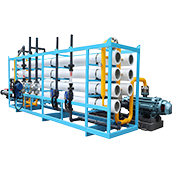
Large-capacity Reverse Osmosis Equipment: Centralized Water Plant Core System
Large-capacity reverse osmosis equipment serves as core water treatment facilities for group factories and industrial park shared water plants. It can be combined into complete sets of Containerized reverse osmosis equipment, and can also be optimized to reach the technical standard of RO equipment with product water conductivity <10μs/cm. Designed for long-term heavy-load continuous operation, this system satisfies the massive stable pure water demand of large-scale industrial clusters.

Product Description
Large-capacity reverse osmosis equipment refers to ultra-large modular water treatment systems with hourly pure water output starting from 50 cubic meters, mainly deployed in regional shared water supply hubs and group-owned manufacturing bases. Many industrial parks rely on multiple medium-scale RO units for combined water production, which brings complicated pipeline layout, scattered operation management and difficult unified energy consumption control. This single large-capacity system effectively solves such systematic operation bottlenecks.
According to project site conditions, customers can choose fixed skid-mounted indoor layout or split assembly to form Containerized reverse osmosis equipment, which adapts to projects without permanent factory buildings. When production processes demand high-purity process water, we can optimize membrane matching and pretreatment configuration to make the unit meet the requirements of RO equipment with product water conductivity <10μs/cm. Multiple groups of independent membrane trains adopt master-slave control architecture, and all finished systems complete long-cycle heavy-load continuous testing before delivery.
Working Principle
Large-capacity reverse osmosis equipment operates on multi-train parallel pressure-driven membrane separation technology. Raw water enters multi-stage graded pretreatment assemblies to intercept suspended sediment, scaling cations and oxidative pollutants, providing comprehensive protection for large quantities of built-in RO membrane elements. After precision security filtration, raw water is pressurized by matched multi-group high-pressure pump sets and evenly distributed to each membrane housing through high-precision balanced manifold pipelines.
Under hydraulic pressure higher than natural osmotic pressure, water molecules penetrate semi-permeable polyamide membranes to form qualified pure water. Dissolved salts, colloids, organic pollutants and microorganisms are intercepted and discharged with concentrated brine. The main PLC controller executes staggered automatic flushing for each independent membrane train, avoiding simultaneous flushing leading to sharp fluctuation of total water yield. Optimized process layout enables the whole system to maintain recovery rate ≥75% under long-term non-stop heavy industrial operation.
Technical Features
1. Multi-group independent membrane train parallel architecture:
Every membrane rack can be independently started or shut down. Operators dynamically adjust running groups according to peak and off-peak water consumption to reduce energy waste during low-load periods.
2. Two deployment modes optional:
Standard fixed indoor skid design is available. Split assembly can be adopted to build Containerized reverse osmosis equipment for temporary construction sites and mobile water supply projects.
3. Adjustable effluent purity configuration:
Different grades of high-rejection RO membrane elements can be selected. After overall optimization, the equipment can reach the standard of RO equipment with product water conductivity <10μs/cm.
4. Master-slave distributed PLC intelligent control:
Equipped with full-range water quality monitoring, multi-level safety interlock protection and staggered automatic flushing. Mass industrial communication interfaces are reserved to connect upper-level water station management platform.
5. Heavy-duty continuous industrial design:
Developed for 24-hour non-stop heavy-load working conditions. The control system automatically adjusts operating parameters to stabilize effluent indicators under raw water quality fluctuation.
Product Advantages
1. Unified centralized operation management:
Single large-capacity unit replaces numerous scattered medium-sized RO equipment. It simplifies complex interconnected pipeline engineering and lowers the difficulty of unified inspection and energy consumption statistical analysis.
2. Optimized full-cycle operation expenditure:
Compared with scattered deployment of multiple medium-sized units, unified power supply and control system reduce repeated investment of auxiliary facilities, cutting long-term labor and maintenance costs.
3. Strong flexible expansion potential:
When regional water demand continues to rise, multiple sets of Large-capacity reverse osmosis equipment can run in parallel to further expand overall water production capacity.
4. Wide adaptability for diversified raw water sources:
Pretreatment assemblies can be customized for surface water, well water and municipal tap water to adapt complex water quality conditions of industrial zones.
5. Humanized overhaul layout design:
The integrated skid reserves wide independent maintenance passages. Universal standardized spare parts effectively shorten downtime required for routine equipment overhaul.
Application Fields
1. Regional industrial shared water supply hubs:
Provide unified standard pure water for dozens of manufacturing enterprises inside industrial zones and realize park-wide water quality supervision.
2. Super-large energy and chemical industrial bases:
Produce large-volume process water for coal chemical, new energy raw material continuous synthesis production lines.
3. Group-level pharmaceutical industrial clusters:
Supply qualified purified water for multiple pharmaceutical workshops to satisfy strict pharmaceutical production water specifications.
4. Large integrated food industrial parks:
Meet massive pure water demand for dairy, beverage and deep food continuous processing production lines.
5. Large centralized boiler make-up water projects:
Mass-produce boiler feed water, slow down pipeline scaling and improve overall thermal efficiency of regional heating facilities.
6. Remote mining and temporary industrial projects:
Adopt Containerized reverse osmosis equipment to build mobile water stations without constructing fixed water treatment workshops.
FAQs
Q1: What stable effluent quality can Large-capacity reverse osmosis equipment maintain under long-term heavy-load operation?
A1: The system can remove over 97% dissolved salts, heavy metal ions and colloidal pollutants. After optimized configuration, it can reach the technical requirements of RO equipment with product water conductivity <10μs/cm for high-purity water production.
Q2: Can single membrane train be offline for maintenance without shutting down the whole equipment?
A2: Yes. The independent parallel architecture supports single membrane train shutdown for overhaul and component replacement. The rest groups keep continuous operation to guarantee basic pure water supply for the whole industrial zone.
Q3: Is this large-capacity system available in mobile container type?
A3: Yes. We can split the assemblies and integrate them into standard containers to manufacture complete Containerized reverse osmosis equipment, applicable to remote mining areas and temporary industrial projects.
Q4: What core measures can reduce membrane fouling risk for large-scale RO systems?
A4: Multi-stage pretreatment needs regular inspection and maintenance. We can add softening and anti-scaling facilities according to raw water quality. Staggered automatic flushing also effectively reduces pollutant accumulation on membrane surfaces.
Q5: Can multiple sets of Large-capacity reverse osmosis equipment operate in parallel to expand overall water yield?
A5: Parallel layout scheme is technically mature. Our engineers can provide complete pipeline and linkage control design for large regional centralized water plant projects.
You May Also Be Interested In