50 Tons/Hour Reverse Osmosis Equipment by Lefilter: Megascale Purification for Industrial & Municipal Demand
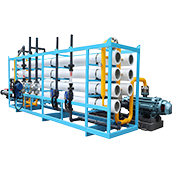
50 Tons/Hour (≈ 11,000 GPH / 264,000 GPD) Reverse Osmosis Equipment from Lefilter represents megascale water treatment capability. This is a significant engineered system, often a cornerstone of a municipal drinking water plant, a major seawater desalination facility, or the process water supply for a mega-industrial complex. It requires extensive design, robust construction, and sophisticated control.
Engineered for Megascale Reliability and Efficiency
At this capacity, the system is a capital-intensive infrastructure project where efficiency, durability, and automated operation are non-negotiable.
Design Philosophy for Large-Scale Plants
Multiple Independent Trains: The system is always divided into multiple, fully independent RO trains (e.g., 4 x 12.5 T/H trains). This provides critical redundancy, allows for maintenance without plant shutdown, and enables flexible operation to match demand.
Sophisticated Intake & Pretreatment: For seawater or poor-quality surface water, the pretreatment system is a major plant in itself, potentially including ultrafiltration (UF) membranes as a robust barrier to ensure high-quality RO feed.
High-Pressure & Energy Recovery: Utilizes high-efficiency, large-capacity pumps and state-of-the-art energy recovery devices (e.g., turbochargers, isobaric chambers) to minimize the dominant operational cost: energy.
Key Advantages of the 50 T/H System
Municipal/Industrial Scale Output: Produces 1.2 million liters per day, capable of supplying a small town or a massive industrial facility.
Lowest Specific Energy Consumption: The design is optimized at every point—pump efficiency, hydraulic losses, membrane selection, and energy recovery—to achieve the lowest possible kWh per cubic meter of product water.
Maximum Operational Flexibility: Multiple trains and advanced controls allow the plant to efficiently operate at 25%, 50%, 75%, or 100% of capacity, adapting to daily or seasonal demand changes.
Full Plant Integration: We can provide the complete package, from intake works and pretreatment to RO, post-treatment, clean-in-place, and product water pumping, all controlled by a unified plant control system.
Technical Specifications
Parameter | Specification for 50 T/H System |
|---|
Nominal Permeate Flow | 50 m³/Hour / 11,000 US GPH / 264,000 US GPD |
Typical Configuration | 4+ independent RO trains for redundancy and flexibility. |
Energy Recovery | Standard on seawater systems; highly recommended for high-recovery brackish systems. |
Pretreatment Standard | Often includes membrane filtration (UF/MF) for challenging sources. |
Membrane Elements | Hundreds of standard 8-inch elements arranged in multi-stage arrays per train. |
Overall Power Demand | Significant; requires dedicated electrical substation coordination. Seawater system with ERD: ~2.5-3.5 kWh/m³. |
Typical Project Applications
Seawater Desalination Plants: For coastal communities, resorts, or industrial parks.
Municipal Water Treatment: For nitrate/fluoride removal or treating brackish groundwater for city supply.
Mega-Facility Process Water: For large petroleum refineries, chemical parks, or data center cooling networks.
Major Power Plant Demineralization: Primary makeup water system for large thermal or nuclear power stations.
Frequently Asked Questions
Q: What is the typical project timeline from order to commissioning?
A: For a system of this scale, the timeline is typically 12-18 months, encompassing detailed engineering, procurement, factory assembly of skids, site civil works, installation, and commissioning.
Q: How is the concentrate managed at this volume?
A: Concentrate management is a key environmental and design consideration. For inland sites, Zero Liquid Discharge (ZLD) with evaporators/crystallizers may be required. For coastal seawater plants, a properly designed outfall with diffusers is standard.
Q: Do you offer financing or Build-Own-Operate-Transfer (BOOT) models?
A: Yes, for large municipal or industrial projects, we can work with financial partners to offer project financing or BOOT/BOO models, where we finance, build, and operate the plant, delivering water under a long-term contract.