10 Tons/Hour Reverse Osmosis System by Lefilter: High-Capacity Process Water Production
The 10 Tons/Hour (≈ 2,200 GPH / 52,800 GPD) Reverse Osmosis System from Lefilter is a major industrial water treatment asset designed for large factories, power stations, and municipalities requiring a very high volume of consistently pure water. This system represents a significant capital investment engineered for maximum uptime, operational efficiency, and long-term reliability.
Designed for High-Volume, Critical Supply
At this scale, the system transitions from a supporting utility to a critical piece of process infrastructure, where reliability and consistent water quality are paramount.
System Architecture for Reliability & Efficiency
Dual-Train Pretreatment: Often configured with dual multimedia and carbon filter vessels to allow for backwashing one train while the other remains online, ensuring uninterrupted feedwater to the RO.
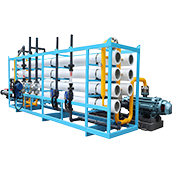
Multi-Stage RO Array with Energy Recovery: The RO section typically consists of multiple parallel racks or a sophisticated multi-stage array. For seawater applications, isobaric energy recovery devices (ERDs) are integrated to dramatically reduce energy consumption.
Comprehensive Instrumentation & Control: Features a full Distributed Control System (DCS) interface or advanced PLC with remote monitoring capabilities. It includes continuous monitoring of key parameters like SDI, ORP, and differential pressure across each stage.
Key Advantages of the 10 T/H System
Large-Scale Water Production: Delivers a substantial 10 m³ per hour, capable of meeting the core process water demands of a large industrial facility.
Optimized for Lowest Lifecycle Cost: Design focuses on minimizing total cost of ownership through high-efficiency pumps, energy recovery options, high membrane recovery rates, and automated chemical cleaning systems.
Built-in Redundancy & Flexibility: The system can be designed with multiple RO trains, allowing one train to be taken offline for maintenance or membrane replacement without shutting down the entire water supply.
Advanced Data Integration: Outputs for full integration into plant-wide SCADA systems, providing operators with real-time performance data and predictive maintenance alerts.
Technical Specifications
Parameter | Specification for 10 T/H System |
|---|
Nominal Permeate Flow | 10 m³/Hour / 2,200 US GPH / 52,800 US GPD |
Standard Recovery | Brackish: 75-85%; Seawater: 40-50% (with ERD) |
Feed Water Capacity | Approx. 13-15 m³/hr (brackish, depending on recovery) |
Membrane Array | Multiple racks with 8-inch elements; common configuration includes a 2-stage design for efficiency. |
High-Pressure Pump | Robust centrifugal pump(s), 22-30 kW power range for brackish. |
Control System | Industrial PLC with large HMI or DCS interface, data logging, and remote access. |
Target Industries & Applications
Power Generation: Primary demineralization system for high-pressure boiler feedwater in thermal power plants.
Large-Scale Electronics Manufacturing: Supply of ultra-pure water (UPW) feed for semiconductor or display fabrication facilities.
Municipal Water Treatment: Brackish water desalination or advanced treatment train for community water supply augmentation.
Major Beverage Production: Central water purification for soft drink or bottled water production at large bottling plants.
Frequently Asked Questions
Q: How is the concentrate (reject) stream managed at this flow rate?
A: Concentrate management is a critical design factor. Options include safe discharge to sewer (if permitted), evaporation ponds, or further treatment in a Zero Liquid Discharge (ZLD) system. Our design maximizes recovery to minimize waste volume.
Q: What level of operator attention is required?
A: The system is highly automated. Daily tasks involve checking instrument readings and chemical tank levels. Weekly checks might include verifying pretreatment backwash cycles. The system alerts operators to required maintenance.
Q: Can the capacity be expanded in the future?
A: Yes, a modular design philosophy is used. The system can be initially built with space and piping provisions to add a parallel RO train in the future, potentially increasing capacity by 100%.
Q: What is the delivery and installation timeline?
A: For a standard brackish water system, delivery is typically 12-16 weeks from order. Installation and commissioning by our team usually require 2-3 weeks on-site.